KCSE continues its work with widows in rural Uganda

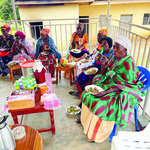


In late January, the annual general meeting of KCSE — Kigando Community Support for the Elderly — heard that the efforts to assist elderly widows in Uganda has stepped up, most notably with daily deliveries of milk to 17 widows and a plan to include fresh vegetables and even chicken rearing.
“Milk has been a game changer,” said the Rev. Caleb Twinamatsiko, rector at the Parish of Pennfield, who heads KCSE. “It has significantly changed their lives health-wise.”
The women who Caleb and his team in Pennfield raise money for have no one to care for them, no income and no support of any kind. Medical care is not free and there are no government support programs.
They all live near the village where Caleb grew up.
“The men are the breadwinners,” he said. “When he dies, they are left with nothing — literally no income.”
BEGINNINGS
For many years, Caleb was the headmaster at Bishop McAllister College in Uganda, which was run by the Rev. Paul Jeffries, a priest from New Brunswick.
After two visits here on behalf of the college, in 2018, Caleb, his wife, Hope Asiimwe, and their two teenaged children moved to the Parish of Pennfield. But in doing so, they left Caleb’s 99-year-old widowed mother behind.
Not long after arriving, Caleb had a crisis of conscience, and he believed he’d made a terrible mistake. That led to a visit back home, where Caleb recognized his mother’s physical needs, and used what he’d learned from visiting the elderly in their homes and in nursing homes here, to make her home more liveable.
“I put a toilet in. I put ramps around the house and railings around the house,” said Caleb. “I had people walk her around and people to get her meals. And I invited older women to come in and have tea with her.”
With his [now late] mother squared away, he and Hope began thinking of the many other widows in similar situations with no one to help care for them.
That was the beginning of KCSE. He found several like-minded parishioners and community members and formed the charity, which received official status from the Government of Canada more than a year ago.
“We started with five women,” said Caleb. “Then the demand came.”
DEMAND FOR SUPPORT
Now the group supports 17 widows each month.
“The need is great, but that’s all we can afford,” Caleb told the board members during the AGM.
When they began, the cost was $15 a month to support a widow. But Uganda is at the mercy of wildly inflated food prices, just as Canada is. Now that monthly support costs $35, more than double.
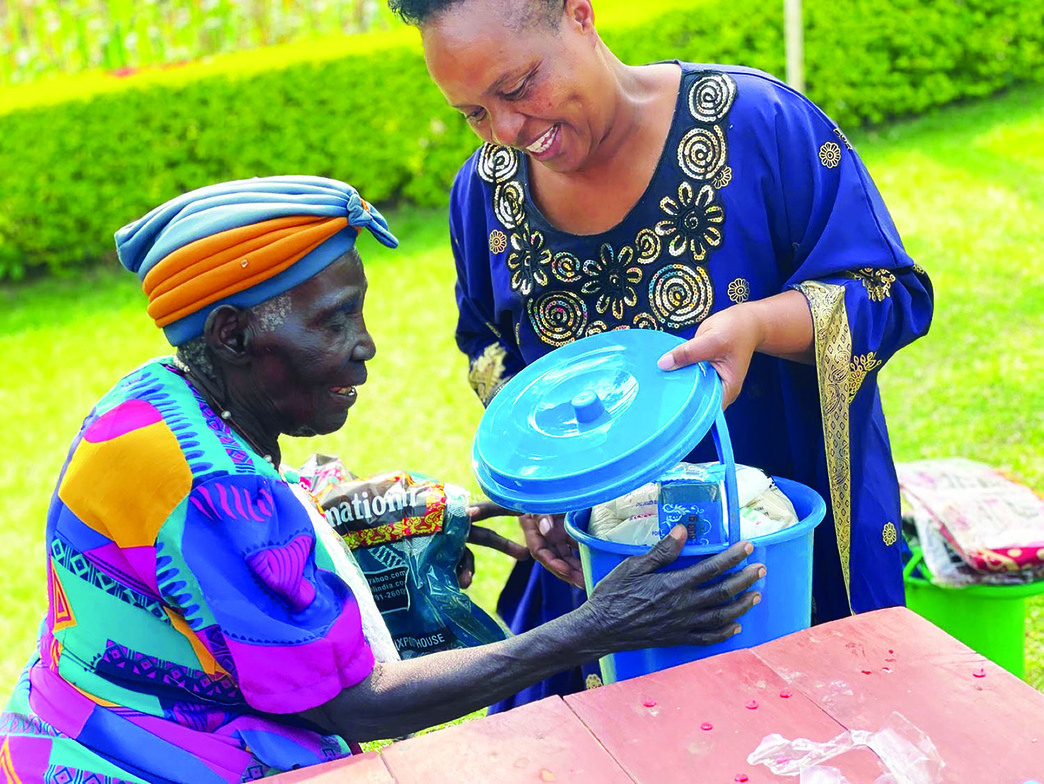
That $35 a month provides the necessities of life: food like tea, sugar, salt, rice, meat and corn flour; hygiene products like soap, toothpaste and a basin; basic needs like clothing, flashlights, kerosene, buckets and cooking pots; medical care and prescriptions; and a popular gathering three times a year with a feast, education and medical intervention, plus transportation to that gathering.
Still, KCSE is a modest Canadian registered charity, with an annual budget of $9,114. A recent audit showed the charity is performing as it should.
It has one volunteer, Arthur, on the ground in Uganda. He does home visits and generally makes sure things run as they should. There is a plan in the works to pay someone $50 a month to take over for Arthur, whose other work responsibilities have increased. Arthur would remain the supervisor.
SUCCESS STORIES
Caleb spent much of the AGM describing the changes to the lives of women who were destitute.
On a visit home, a local leader drew Caleb’s attention to Bashasha, who had fallen ill and was living alone.
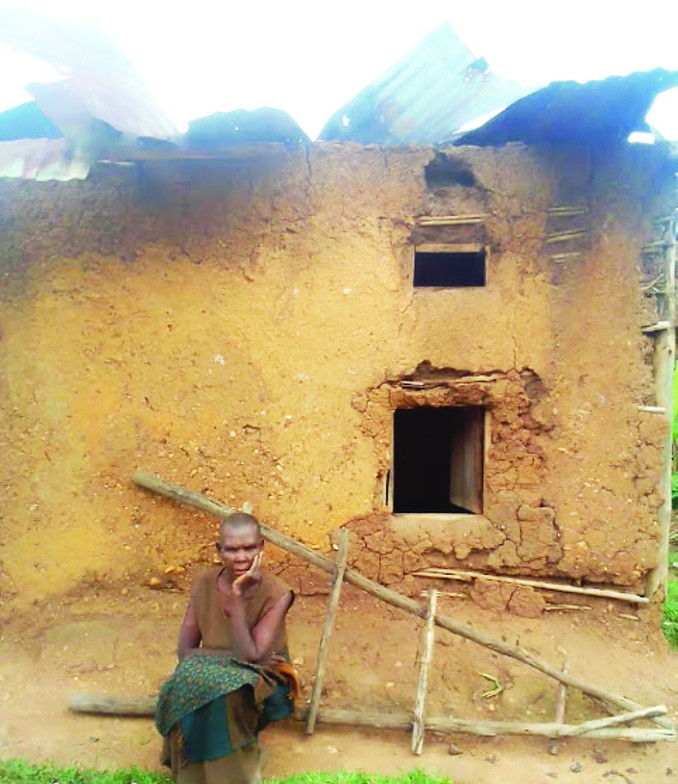
“She was unable to sit or stand due to prolonged illness,” said Caleb, adding she spent every day lying on a mat on a mud floor.
She was relying on a neighbour, who could barely afford to feed herself, for food. She had lost the use of virtually all her muscles.
With some medical intervention, paid for by KCSE, she is able to sit without support. While she will probably never walk again, her life is markedly improved, and she is buoyed by the concern and practical help she’s received from KCSE.
Another woman, Jolly, is improving after being attacked by her drug-addicted son. She was severely injured, including a broken arm, but is recovering thanks to medical aid provided by KCSE.
The women who are able, make crafts such as baskets and mats. The supplies are provided by KCSE and are sold to provide the women with a small income.
GATHERINGS
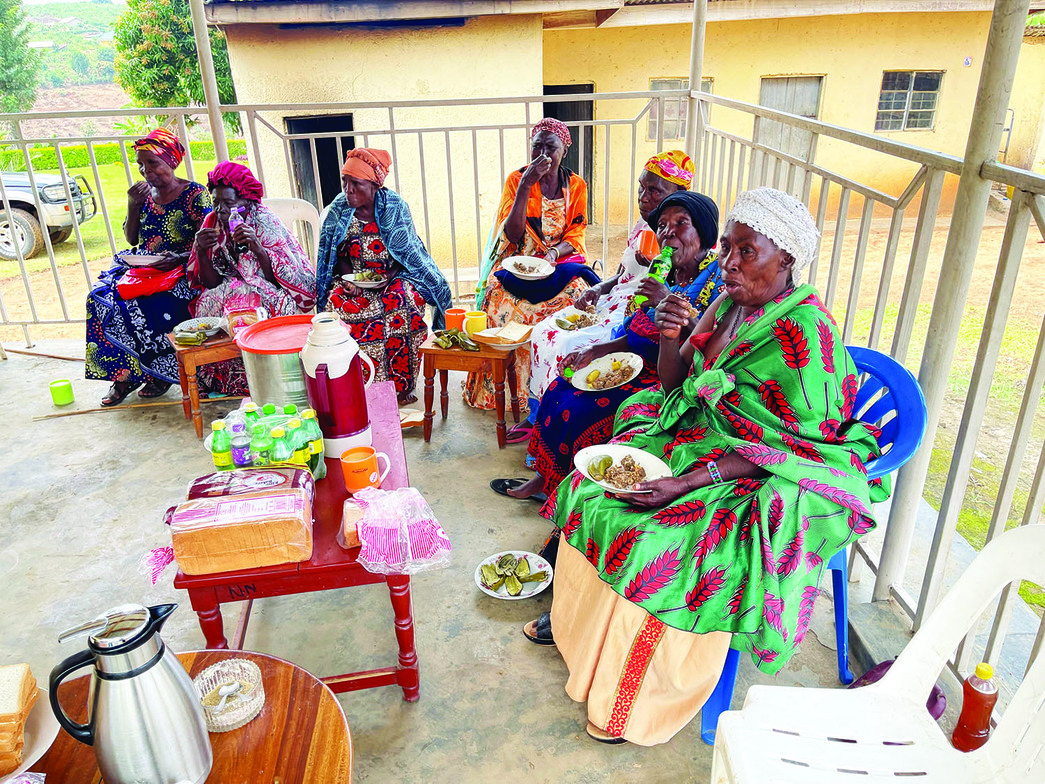
When the women gather three times a year, it’s a real celebration, said Caleb. The isolation and loneliness they experience vanish during these times together.
“These gatherings bring such joy and enthusiasm to the women, sometimes so intense that it becomes difficult to conclude the activities.”
Usually a doctor, nurse or both are in attendance to do health screenings: blood tests, blood pressure readings and so on.
There is also a health education component, with lessons on basic hygiene and public health. As a result, the women have adopted new practices they’ve learned.
The food they are now receiving has also helped improve their overall health.
Caleb showed video and photos of the gatherings, including one where the women were singing to the camera.
“They are saying thank you, so this is for you,” he told the board members. “This thank-you goes to all of you.”
FUTURE PLANS
Caleb and the board are not content to simply continue what they’re doing.
At the AGM, Caleb proposed taking the recommendations of health professionals and include fresh foods as part of the monthly support. Vegetables and eggs are on his list.
“I propose allocating $18 a month per woman to buy these locally,” he said.
He outlined the benefits: increased interaction with neighbours through food and money exchanges; enhanced community involvement and enhanced reputation of KCSE; and help for impoverished vendors through the purchases, not to mention improved nutrition.
He’s also learned that 11 of the 17 women they support are capable of raising chickens.
“I suggest a one-time supply of chickens, valued at $165 total, to enable them to begin adding eggs to their diet,” he said.
It will be a much-needed source of protein.
All the proposals were accepted.
How will the group pay for these extra expenditures? They plan twice monthly fundraising dinners, one in St. Andrews and one in St. George.
Caleb has a further, long-term goal: a facility where seniors can meet to interact and share, but also receive the necessary social and medical supports.
He thanked the board, and quoted James 1:17: Religion that God our Father accepts as pure and faultless is this: to look after orphans and widows in their distress.”
DONATIONS: Cheques can be mailed to KCSE, 68 Route 778, Pennfield, NB, E5H 2B4
OR E-transfers can be sent to kcseinc@gmail.com
Photo captions:
1. Women share a meal after arriving for their gathering — a social, educational and emotional time for them.
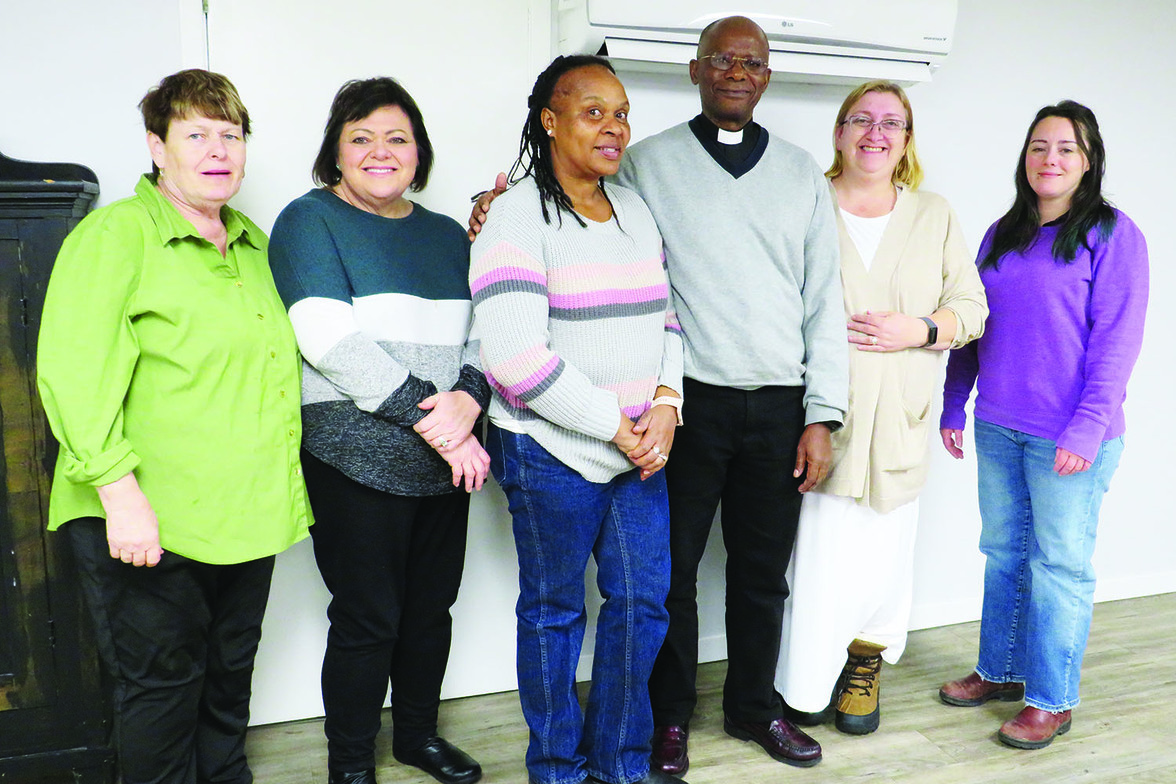
2. Members of the KCSE board: Betty Anthony, Laura Lee Carrier, Hope Twinamatsiko, the Rev. Caleb Twinamatsiko, Nicole Sangster, Sarah Norman. McKnight photo
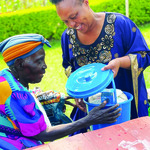
3. Hope Twinamatsiko gives out household items at a gathering.
4. Life is lonely and sparse for widows in Uganda.
Photos courtesy of Caleb Twinamatsiko